Hi biology student! My name is Nakul Nagaraj (follow me on instagram @nakul_nagaraj), and I am now a sophomore at Saratoga High School. It may be a bit scary because it is your first day, but Mr. Orre's class isn't too hard if you know what you are doing.
In the beginning of each class, you will complete the "Do Now" on the board and then review the vodcast. Make sure you do every vodcast on time because if you miss one they are hard to catch up on. Also, if you don't do the vodcast, you will have no idea what is going on in class. They are also usually the only homework you will have for this class. Plan on spending 20 minutes on each vodcast. Another thing that you do this class that you may not be used to in a blog. Every time you do a lab or finish a unit you will write a reflection on your blog. You usually have time to do this in class and don't have to do it for homework.
Mr. Orre is usually pretty forgiving and understanding but he will get made if you don't use your common sense and do dumb things. Something he also hates is when people don't listen to instructions and he has to repeat himself. Remember that homework is worth more of your grade than tests so don't procrastinate. As long as you review the unit before a test you should do fine on the test. Some mistakes I made early on were procrastinating the textbook notes you do each unit, not doing a vodcast, and stressing too much about the tests.
I think that this is a pretty good class. You will probably hear some negative things about this class but you will definitely learn a lot. Make sure you stay on top of things and follow directions and you will do great in this class.
From,
Nakul
Thursday, June 1, 2017

Tuesday, May 30, 2017
Pig Dissection
The purpose of this lab was to learn about the anatomy and physiology of a pig and how it relates to our bodies. The internal organs of a pig are similar in location and function to those of a human. This unit we learned about all the organ systems and functions of the human body. This dissection allowed us to see first hand how the systems fit and linked together to work in the body. My favorite part of the dissection was probably the end, because all the organs were exposed and I could clearly see how they all fit together and worked. I think it was a valuable experience because it was really cool and I learned a lot about how the body works.
Tuesday, May 9, 2017
Unit 9 Reflection
In this unit we learned about taxonomy and how organisms are classified into their kingdoms, phyla, and classes. The more closely related organisms are, the more close they are classified. We looked at the tree of life a lot, and how it shows evolutionary relationships. It also shows where and when species became reproductively isolated and that shows why organisms have the features they do today. Organisms are divided into domains, kingdoms, phyla, classes, orders, families, genuses, and finally species. This classification helps scientists organize species. They also use cladograms, which show evolutionary relationships and traits.
There are three Domains in the three domain system. Eukaryota, Bacteria and Archaea. Archaea are like bacteria but certain traits cause them to be in a separate domain. They live in some of the most harsh environments on earth, often without oxygen. Bacteria are also single celled and have no nucleus. They are in two kingdoms, gram-positive and gram-negative. Viruses are technically not living but some theorize that they are the origin of life on this planet.
The Domain Eukaryota contains the kingdoms protists, plantae, animalia, and fungi. All eukaryotic cells have a nucleus. Protists are organisms that are hard to classify, and therefore it is the most diverse kingdom. Plantae is all plants, including vascular and non-vascular plants. Plants do photosynthesis to create energy for themselves. Fungi are very different from plants. They are heterotrophic, and one of the main decomposers. They have cell walls that are made of chitin and can reproduce sexually or asexually. The typed of fungi are bread molds, sac fungi, and club fungi.
The Domain Animalia contains all animals. 97% of animals do not have a backbone. The most primative animal is the sponge. Cnidarians are similar but are more complex and have tissue. Flatworms can move around but do not have a complete digestive tract. Mollusks have a digestive tract and a respiratory system. Arthoropods include insects, and have a exoskeleton. Crustaceans are similar to arthropods but in the water. Echinodermata have a water vascular system that can allow them to move.

Vertibrates make up the rest of the animal kingdom. All vertibrates are part of the phylum chordata. Agnatha were the first vertibrates and were jawless fish. Condricthyes are fish that have a jaw and cartilage skeleton. Osteicythes have jaws and bony skeletons. Amphibians are the transitionary class because they could live in water and land. The tiktallic was a trainsitional species that could get out of water and climb on land. This was a big breakthrough, because it allowed other species to evlolve to live on land.
 Reptiles are ectothermic, cold blooded, and have 3 chambered hearts. Aves, or birds, have hollow bones and feathers. Mammals are endothermic and have complex reproductive and behavioral traits. Humans are mammals and have millions of years of ancestry and evolution to have the traits we have today.
There were no hard or complex concepts in this unit, only lots of content. There are a lot of phyla with certain characteristics to remember. Some questions I have are how do species develop new traits and even organs? How many more species are out there that we have not yet discovered? What species will take over once humans go extinct?
I think my presentation on the banana went pretty good. One thing I did not take into account was that I would speak faster in the presentation compared to practice, and therefore my presentation was a little bit short. I wanted to make eye contact and engaging with the audience a priority in my presentation, as I found it very boring to watch other people stand in the front of the room and read off a screen. To make sure I did not do this, I looked at the screen for a second every time I changed a slide so I could see what was on it and speak to the class about it. Presenting is a useful skill to have, as selling an audience or convincing a directed audience to agree with you or support you is extremely valuable.
There are three Domains in the three domain system. Eukaryota, Bacteria and Archaea. Archaea are like bacteria but certain traits cause them to be in a separate domain. They live in some of the most harsh environments on earth, often without oxygen. Bacteria are also single celled and have no nucleus. They are in two kingdoms, gram-positive and gram-negative. Viruses are technically not living but some theorize that they are the origin of life on this planet.
The Domain Eukaryota contains the kingdoms protists, plantae, animalia, and fungi. All eukaryotic cells have a nucleus. Protists are organisms that are hard to classify, and therefore it is the most diverse kingdom. Plantae is all plants, including vascular and non-vascular plants. Plants do photosynthesis to create energy for themselves. Fungi are very different from plants. They are heterotrophic, and one of the main decomposers. They have cell walls that are made of chitin and can reproduce sexually or asexually. The typed of fungi are bread molds, sac fungi, and club fungi.
The Domain Animalia contains all animals. 97% of animals do not have a backbone. The most primative animal is the sponge. Cnidarians are similar but are more complex and have tissue. Flatworms can move around but do not have a complete digestive tract. Mollusks have a digestive tract and a respiratory system. Arthoropods include insects, and have a exoskeleton. Crustaceans are similar to arthropods but in the water. Echinodermata have a water vascular system that can allow them to move.

Vertibrates make up the rest of the animal kingdom. All vertibrates are part of the phylum chordata. Agnatha were the first vertibrates and were jawless fish. Condricthyes are fish that have a jaw and cartilage skeleton. Osteicythes have jaws and bony skeletons. Amphibians are the transitionary class because they could live in water and land. The tiktallic was a trainsitional species that could get out of water and climb on land. This was a big breakthrough, because it allowed other species to evlolve to live on land.

There were no hard or complex concepts in this unit, only lots of content. There are a lot of phyla with certain characteristics to remember. Some questions I have are how do species develop new traits and even organs? How many more species are out there that we have not yet discovered? What species will take over once humans go extinct?
I think my presentation on the banana went pretty good. One thing I did not take into account was that I would speak faster in the presentation compared to practice, and therefore my presentation was a little bit short. I wanted to make eye contact and engaging with the audience a priority in my presentation, as I found it very boring to watch other people stand in the front of the room and read off a screen. To make sure I did not do this, I looked at the screen for a second every time I changed a slide so I could see what was on it and speak to the class about it. Presenting is a useful skill to have, as selling an audience or convincing a directed audience to agree with you or support you is extremely valuable.
Wednesday, April 19, 2017
Geologic Timeline Individual Reflection
The first major event in Earths history was the beginning of photosynthesis in cynobacteria. This is important because it increased the oxygen content in the atmosphere which led to the rise of eukaryotes and later plants and animals. Animals cannot survive without enough oxygen so we would not be here if it had not been for this event.
The second major event was the Permian extinction at the end of the Paleozoic Era. It was the largest mass extinction in Earth's history killing 80% of all life. This loss of life was necessary for the explosion of new life that happened afterwards. The absence of many species allowed dinosaurs to occupy the empty niches and start the era of Dinosaurs.
The third important event happened in the tertiary period when birds, mammals and flowering plants began to dominate. This happened when the dinosaurs went extinct after the cretaceous and the evolution of mammals led to the first humans. Without this event humans may not exist or be much different than what we are today.
The scale of Earth's history is incredibly massive. It surprised me looking at the timeline that all the eras and periods we talk about are all in the span of only about a meter. The Earth was barren with little to no life for most of history. When reading about it it seems that all the eras and periods are roughly the same length but looking at it you can see that the Precambrian Era is most of Earth's history.
Humans have had such a great impact on Earth in just a few hundred years. And most of our impact has happened in the last hundred. We are destroying ecosystems that took hundreds of millions of years to evolve in just years. Humans have existed for just a few thousand years, and have done more in a blink than any other species has done in millions of years.
Some questions I have are why did it take so long for life to take off and start evolving? Why did some species go extinct? Where there intelligent species in the past that went extinct? Why did the planet evolve the way it did?

The second major event was the Permian extinction at the end of the Paleozoic Era. It was the largest mass extinction in Earth's history killing 80% of all life. This loss of life was necessary for the explosion of new life that happened afterwards. The absence of many species allowed dinosaurs to occupy the empty niches and start the era of Dinosaurs.
The third important event happened in the tertiary period when birds, mammals and flowering plants began to dominate. This happened when the dinosaurs went extinct after the cretaceous and the evolution of mammals led to the first humans. Without this event humans may not exist or be much different than what we are today.
The scale of Earth's history is incredibly massive. It surprised me looking at the timeline that all the eras and periods we talk about are all in the span of only about a meter. The Earth was barren with little to no life for most of history. When reading about it it seems that all the eras and periods are roughly the same length but looking at it you can see that the Precambrian Era is most of Earth's history.
Humans have had such a great impact on Earth in just a few hundred years. And most of our impact has happened in the last hundred. We are destroying ecosystems that took hundreds of millions of years to evolve in just years. Humans have existed for just a few thousand years, and have done more in a blink than any other species has done in millions of years.
Some questions I have are why did it take so long for life to take off and start evolving? Why did some species go extinct? Where there intelligent species in the past that went extinct? Why did the planet evolve the way it did?

Thursday, April 13, 2017
20 Time Project Update
I am still set on the path I identified in my last blog post. I am on track for working with Mr. Fitzgerald to help him in his garden. I further researched native plants and how to grow them in a greenhouse (Mr. Fitz plans on having a greenhouse built soon). Also, a possible project on building a worm bin may be available for me so I researched that too. Basically, I have been doing a lot of reading and research to learn more about my topic and be prepared when its time for me to take the next step in my project.
Friday, April 7, 2017
Unit 8 Reflection
Unit 8 was about evolution and how and why species evolve. Evolution can be measured as a change in the frequency of an allele in the gene pool. The gene pool is the the total number of genes in a population. One of the main forces that sparks change in the gene pool is natural selection, the theory that the "winners," or individuals with better traits survive and reproduce to pass their genes on while the individuals with traits that don't help survival die and take their genes with them. We explored this in the Hunger Games Lab. When we tested this, the individuals with traits that helped them pick up food increased in population while the individuals with bad traits nearly died off. The allele frequency was graphed and showed the allele frequency change, showing that evolution was occurring.
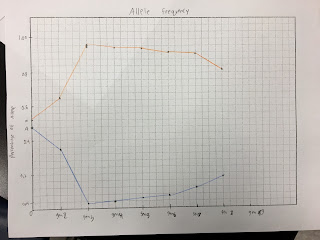 The type of natural selection exhibited in this lab was directional selection, where one extreme phenotype, in this case the pincher, was favored so the phenotypes shift towards that. Stabilizing selection is where the average phenotype in the middle are favored and extremes are not. This keeps the population from changing. Disruptive selection is when both extremes are favored and the graph splits in two. This is often the beginning of speciation.

Natural selection is not the only thing that can change allele frequency. Genetic drift is when random acts kill random members of the population, eliminating them from the gene pool. This can be harmful because it lowers genetic variation. Gene flow is movement of alleles between populations, and mutations can also change allele frequency. Sexual selection traits are traits that increase chance of mating but do not help an individual survive.
New species are created in a process called speciation. When a species is reproductively isolated, they begin to drift apart until they are two different species. They become different species in a process called evolution. There is evidence to prove evolution exists. There are certain traits that modern day organisms have that are useless but would have been useful to ancestors. Also, similarities between species point to a common ancestor in the distant past.
Earths vast history is split up into eras, periods, and epochs. Mass extinctions mark the end of many of these. Each time period has different characteristics.
This unit was not a very difficult unit, but the scale of the Earth's timeline is hard to comprehend. Some questions I have are how did unicellular organisms turn into multicellular organisms and then plants and animals. Also how did asexually reproducing organisms evolve and become sexually reproducing.
I have had a chance to be more assertive in the geological timeline project. I have realized that there is a time to be a leader and be slightly more aggressive for the better of the group, but also a time to sit back more passively to better the group. But mostly, I have been assertive by leading with clear logical steps and listening to the ideas of others.


http://www.course-notes.org/biology/topic_notes/33_behavioral_ecology/fecundity_selection
New species are created in a process called speciation. When a species is reproductively isolated, they begin to drift apart until they are two different species. They become different species in a process called evolution. There is evidence to prove evolution exists. There are certain traits that modern day organisms have that are useless but would have been useful to ancestors. Also, similarities between species point to a common ancestor in the distant past.
Earths vast history is split up into eras, periods, and epochs. Mass extinctions mark the end of many of these. Each time period has different characteristics.
This unit was not a very difficult unit, but the scale of the Earth's timeline is hard to comprehend. Some questions I have are how did unicellular organisms turn into multicellular organisms and then plants and animals. Also how did asexually reproducing organisms evolve and become sexually reproducing.
I have had a chance to be more assertive in the geological timeline project. I have realized that there is a time to be a leader and be slightly more aggressive for the better of the group, but also a time to sit back more passively to better the group. But mostly, I have been assertive by leading with clear logical steps and listening to the ideas of others.
Wednesday, March 29, 2017
Hunger Games Final Analysis
1. In this lab we simulated generations of a population by having each generation have to get enough food to survive and reproduce.
2. The pincher was the most successful at getting food because it could do it very easily and quickly, leading to survival and reproduction.
3. The population did evolve because the allele frequency changed. The allele frequency was roughly equal in the beginning but by the third generation the A allele only consisted of 3% of the total alleles and the a allele was 97%. This is a drastic change in the allele frequency, and it showed in the phenotypes as most of the populations were pinchers, with few knucklers and no stumpys while the amount of each phenotype was equal in the beginning.
4. The food placement was often random and reproduction usually created a random offspring (given that the traits were present). Sometimes the food was not random and favored some over others. This could affect evolution because it can favor some without the best traits and cause some with the best traits to die to to chance.
5. If the food was smaller it may favor pinchers even more, but if it was large it may favor stumpys instead. If the food source changes or one food source goes down or extinct individuals with certain traits who were not favored before may be favored then.
6. the results may have been different if there was no incomplete dominance. There would be no knucklers, only stumpys and pinchers. At one point in the lab the stumpys went extinct but came back thanks to the knuckers. If they went extinct with no incomplete dominance they wouldn't be able to come back.
7. Evolution is caused by natural selection. Natural selection picks the individuals with the best survival traits to survive and reproduce. By weeding out the bad traits, those soon disappear or become less common while the better traits become more common, changing the population.
8. Individuals often mated with other individuals of the same phenotype, which cause the knucklers and stumpys to stick around. This relates to sexual selection found in nature. To increase chances of survival individuals sometimes cheated to get their food and stole from others. This can also happen in nature.
9. In evolution populations evolve. Natural selection acts on the genotype which affects the phenotype. Natural selection affects what genes are passed from parents to offspring which determines their traits.
10. What are more examples of events or things that could change a population? How have humans affected this process?

2. The pincher was the most successful at getting food because it could do it very easily and quickly, leading to survival and reproduction.
3. The population did evolve because the allele frequency changed. The allele frequency was roughly equal in the beginning but by the third generation the A allele only consisted of 3% of the total alleles and the a allele was 97%. This is a drastic change in the allele frequency, and it showed in the phenotypes as most of the populations were pinchers, with few knucklers and no stumpys while the amount of each phenotype was equal in the beginning.
4. The food placement was often random and reproduction usually created a random offspring (given that the traits were present). Sometimes the food was not random and favored some over others. This could affect evolution because it can favor some without the best traits and cause some with the best traits to die to to chance.
5. If the food was smaller it may favor pinchers even more, but if it was large it may favor stumpys instead. If the food source changes or one food source goes down or extinct individuals with certain traits who were not favored before may be favored then.
6. the results may have been different if there was no incomplete dominance. There would be no knucklers, only stumpys and pinchers. At one point in the lab the stumpys went extinct but came back thanks to the knuckers. If they went extinct with no incomplete dominance they wouldn't be able to come back.
7. Evolution is caused by natural selection. Natural selection picks the individuals with the best survival traits to survive and reproduce. By weeding out the bad traits, those soon disappear or become less common while the better traits become more common, changing the population.
8. Individuals often mated with other individuals of the same phenotype, which cause the knucklers and stumpys to stick around. This relates to sexual selection found in nature. To increase chances of survival individuals sometimes cheated to get their food and stole from others. This can also happen in nature.
9. In evolution populations evolve. Natural selection acts on the genotype which affects the phenotype. Natural selection affects what genes are passed from parents to offspring which determines their traits.
10. What are more examples of events or things that could change a population? How have humans affected this process?

Saturday, March 18, 2017
20 Time Garden Project Update
Lots has happened in the past few weeks pertaining to my 20 time garden project. My path has been redirected slightly, but in a good way. I talked with Mr. Fitzgerald, a science teacher at Redwood Middle School, about the Redwood school garden. He is in charge and has a lot of ideas on how to make the garden and the campus a better place. I would like to dedicate my 20 time to helping him achieve this. He has ideas on planting native plants around the school to beautify the campus and teach students about the importance of native plants. He also has projects planned for the garden such as a greenhouse and a worm composting bin. I have spent time researching these things to ensure these projects are as successful as they can be. I would like to further research these topics and make a landscape plan for the native plants.
Monday, March 6, 2017
Unit 7 Reflection
This unit was about ecology and some of the harmful effects humans have on the planet. One of the most important concepts in ecology is trophic levels and the food web. This explains how energy moves through an ecosystem and also shows how an ecosystem can collapse. Population is another factor that influences ecosystems. Populations change frequently and are dependent on factors like water, resources, food and space. When the growth of a population levels out, it is said that the species has reached its carrying capacity. Humans have not reached the carrying capacity yet but population growth has slowed down. Limitations of resources are the main limitation for species. To keep resources available, several crucial cycles such as the water cycle, carbon cycle, phosphorous cycle, and nitrogen cycle.

Humans are exploiting these resources and endangering ecosystems and species across the planet. Habitat destruction, climate change, and over exploitation are some of the main reasons the planet is this way. We need to act fast to preserve biodiversity, slow climate change, and reduce the amount of resources we use and pollutants and waste we create. If everyone makes a conscious effort to save the Earth, it will add up for the benefit.
Some questions I have are is it too late? What will happen when we exhaust all the natural resources? How are animals adapting to these changes? What can we do to help?
Our conservation biologist project went pretty well. We worked well as a group to complete the project on time. Everyone finished their share of work so we didn't have to worry. Like all group projects, it could be frustrating at times because you have to compromise and things don't always go as planned.
On the self assessment, I was not surprised with my results. I am fairly assertive but also sometimes passive. In my everyday life I have noticed that I do not always speak up when I probably should. I think if I act assertive like it says in the video, it will definitely make me a more assertive person.
https://www.thinglink.com/scene/732996661223096321
Humans are exploiting these resources and endangering ecosystems and species across the planet. Habitat destruction, climate change, and over exploitation are some of the main reasons the planet is this way. We need to act fast to preserve biodiversity, slow climate change, and reduce the amount of resources we use and pollutants and waste we create. If everyone makes a conscious effort to save the Earth, it will add up for the benefit.
Some questions I have are is it too late? What will happen when we exhaust all the natural resources? How are animals adapting to these changes? What can we do to help?
Our conservation biologist project went pretty well. We worked well as a group to complete the project on time. Everyone finished their share of work so we didn't have to worry. Like all group projects, it could be frustrating at times because you have to compromise and things don't always go as planned.
On the self assessment, I was not surprised with my results. I am fairly assertive but also sometimes passive. In my everyday life I have noticed that I do not always speak up when I probably should. I think if I act assertive like it says in the video, it will definitely make me a more assertive person.
https://www.thinglink.com/scene/732996661223096321
Monday, February 13, 2017
Saratoga High School Garden
In short, 20 time is spending 20% of your time on something you are passionate, in the form of a project or anything else you can think of. It is meant to be creative and self motivated. The essential question I am asking is could there be a garden at Saratoga High. For my project, I am researching, and if possible, I want to see what needs to be done to create a rooftop garden, or any garden, at Saratoga High. I have always liked gardening, and I know that there are many benefits to having a garden at a school. SHS does not have a garden, so implementing a garden could help many people. My goals are to have either a garden at the school, or have the administration or staff strongly considering a garden by the end of the year. I will measure my progress by researching and answering all of my obstacles and questions that need to be answered to get this built. In the future, I hope to use class time to figure out logistics involving the garden, and contacting administration in hopes they will support this project.
Tuesday, January 31, 2017
Unit 6 Reflection
This unit was about biotechnology, its uses, and the ethical questions it raises. We learned how DNA can be recombined and inserted into a new organism through a plasmid. By inserting a gene into a plasmid and inserting the plasmid into bacteria, the bacteria will treat the new gene as its own and produce whatever protein it codes for. After introducing the plasmid to bacteria, they place the bacteria in food to make them grow and then put them into the antibiotic the plasmid provides resistance too. This ensures that all bacteria without the plasmid will die.
To learn how to analyze DNA and how to measure the lengths of the strands of DNA we did the gel electrophoresis lab. http://nakulbiology.blogspot.com/2017/01/candy-electrophoresis-lab.html We cut out DNA using restriction enzymes and tested their lengths by running them through a gel.

The pGLO lab incorporated all the things we had learned about biotech. We had several different samples of bacteria and treated each with different things. After the lab, as expected, the bacteria with the pGLO gene inserted, the ampicillin resistance, and the arabinose glowed under UV light. http://nakulbiology.blogspot.com/2017/01/pglo-lab.html

I understood this unit pretty well. It was not very long and the hands on labs helped me in my understanding. While reading the concepts of the labs I was confused, but after doing the lab it made perfect sense to me why everything happened as it did. Seeing the concepts in action really helped me see what was going on. I wonder how biotech will play a role in society in the future. Will altering multi-cellular organisms be common? Will we ever alter human DNA or clone a human?
I think I have done a good job on my New Years resolutions. I finished my chapter notes early so I wasn't stressed or piled up with work. Also, I finished most of my homework assignments early or on time. I could still improve by preparing for tests sooner instead of procrastinating my studying.
To learn how to analyze DNA and how to measure the lengths of the strands of DNA we did the gel electrophoresis lab. http://nakulbiology.blogspot.com/2017/01/candy-electrophoresis-lab.html We cut out DNA using restriction enzymes and tested their lengths by running them through a gel.

The pGLO lab incorporated all the things we had learned about biotech. We had several different samples of bacteria and treated each with different things. After the lab, as expected, the bacteria with the pGLO gene inserted, the ampicillin resistance, and the arabinose glowed under UV light. http://nakulbiology.blogspot.com/2017/01/pglo-lab.html

I understood this unit pretty well. It was not very long and the hands on labs helped me in my understanding. While reading the concepts of the labs I was confused, but after doing the lab it made perfect sense to me why everything happened as it did. Seeing the concepts in action really helped me see what was going on. I wonder how biotech will play a role in society in the future. Will altering multi-cellular organisms be common? Will we ever alter human DNA or clone a human?
I think I have done a good job on my New Years resolutions. I finished my chapter notes early so I wasn't stressed or piled up with work. Also, I finished most of my homework assignments early or on time. I could still improve by preparing for tests sooner instead of procrastinating my studying.
Saturday, January 28, 2017
pGLO Lab
1.
Plate
|
Number of Colonies
|
Color of colonies under room light
|
Color of colonies under UV light
|
-pGLO LB
|
covered
|
brownish yellow
|
whitish blue
|
-pGLO LB/amp
|
0
|
N/A
|
N/A
|
+pGLO LB/amp
|
100~
|
brownish yellow
|
whitish blue
|
+pGLO LB/amp/ara
|
22
|
brownish yellow
|
glowing green
|
2. The bacteria from the +pGLO LB/amp/ara plate gained two new traits. The transformed bacteria are resistance to ampicillin and the ability to glow under UV light. They did not die in the presence of ampicillin, and glowed under the light.
3. Each transformed bacteria must have multiplied into a colony, so about 100 bacteria were transformed in the +pGLO LB/amp. The bacteria that did not pick up the plasmid would have been killed by the ampicillin. Probably half of the bacteria died in the plate, so probably over 250 bacteria were present in the 100 micro-liters.
4. The purpose of arabinose is to "turn on" the GFP or Green Fluorescent Protein. This causes the bacteria to glow green under UV light.
5. There are several uses for GFP for biologists. It can be used as a marker when inserting a gene into a cell. If the cell glows, it means the other gene inserted is also being expressed. The protein has also been altered to react to different wavelengths and express several different colors.
6. Another practical application of genetic engineering is in food production weather it be animals or crops. Genetic engineering can make an animal or plant stronger, bigger, or more resistant to disease.


Source: https://embryo.asu.edu/pages/green-fluorescent-protein
Wednesday, January 18, 2017
Candy Electrophoresis Lab
I this lab, we asked the question of can molecules in food dye be separated in gel electrophoresis. We found that the dyes did separate, by observing the different groups of dye after electrophoresis. We learned from our textbook and the vodcasts, that smaller molecules of DNA travel faster and farther in electrophoresis, and larger molecules travel slower. The data is consistent with these scientific principles, because the dyes with the larger molecules did not travel as far as the smaller moleculed dyes.

1. In our experiment the bands were about the same size as the reference dyes. In some cases, our dyes were different colors than the reference dyes so they did not match up. None of the dyes moved towards the negative charge.
2. Of the dyes listed, betanin and citrus red 2 would move like our red dye, but citrus red 2 would move faster because it is a smaller molecule. Also, fast green FCF would move similarly to our green dye because it is similar in size.
3. Dog food manufacturers would put artificial colors in the food to make it more visually appealing and consumers are more likely to buy a food that is colorful and nice looking than a food looking unappealing and bland looking.
5. The factors that control how far the dyes go are time and size of molecule. The longer the electrophoresis is on for, the farther the dyes will travel. Also, the smaller molecules will travel faster, and therefore farther in the allowed time.
6. The force that allows the dyes to move through the gel is electricity. When the current runs though the gel, the molecules are repelled by the negative charge, because they are also negatively charged, and attracted to the positive charge, which propels them through the gel.
7. The gel is the component that separates the molecules by size. If it was a liquid for example, all the molecules would travel at the same speed, but the gel makes it harder for larger molecules to travel, separating out the sizes.
8. DNA molecules with different weights would separate out in different groups. The DNA with the molecular weight of 600 daltons would form a band ahead of the rest. Following would be the 1000, 2000, and 5000 in that order.


1. In our experiment the bands were about the same size as the reference dyes. In some cases, our dyes were different colors than the reference dyes so they did not match up. None of the dyes moved towards the negative charge.
2. Of the dyes listed, betanin and citrus red 2 would move like our red dye, but citrus red 2 would move faster because it is a smaller molecule. Also, fast green FCF would move similarly to our green dye because it is similar in size.
3. Dog food manufacturers would put artificial colors in the food to make it more visually appealing and consumers are more likely to buy a food that is colorful and nice looking than a food looking unappealing and bland looking.
5. The factors that control how far the dyes go are time and size of molecule. The longer the electrophoresis is on for, the farther the dyes will travel. Also, the smaller molecules will travel faster, and therefore farther in the allowed time.
6. The force that allows the dyes to move through the gel is electricity. When the current runs though the gel, the molecules are repelled by the negative charge, because they are also negatively charged, and attracted to the positive charge, which propels them through the gel.
7. The gel is the component that separates the molecules by size. If it was a liquid for example, all the molecules would travel at the same speed, but the gel makes it harder for larger molecules to travel, separating out the sizes.
8. DNA molecules with different weights would separate out in different groups. The DNA with the molecular weight of 600 daltons would form a band ahead of the rest. Following would be the 1000, 2000, and 5000 in that order.

Monday, January 9, 2017
New Years Goals
1. This semester I will be more organized in my work.
I often struggle to find things and get things done efficiently because my things are not in one organized place and are often strewn across many places. Having things in one place will make it easier to finish work on time and study. Also, a schedule will allow me to organize my time better.
2. I will finish textbook notes earlier.
I have sometimes done this and sometimes not. By finishing the textbook notes earlier, it will allow me to learn better and be less stressed about completing them. When I procrastinated and put off the notes, I did not learn from them because I was more focused on finishing then obtaining the information.
I often struggle to find things and get things done efficiently because my things are not in one organized place and are often strewn across many places. Having things in one place will make it easier to finish work on time and study. Also, a schedule will allow me to organize my time better.
2. I will finish textbook notes earlier.
I have sometimes done this and sometimes not. By finishing the textbook notes earlier, it will allow me to learn better and be less stressed about completing them. When I procrastinated and put off the notes, I did not learn from them because I was more focused on finishing then obtaining the information.
Wednesday, December 14, 2016
Unit 5 Reflection
Unit 5 was all about DNA, RNA, and their functions. DNA is a double helix structure that has nucleotides that code for proteins. The nitrogen bases are Adenine, Thymine, Guanine, and cytosine. A and T pair up while G and C pair up.
When RNA needs to be made, an enzyme called RNA polymerase unzips the DNA and pairs a nucleotide with each strand of DNA. In RNA, the base Thymine is replaced with Uracil (U). This single stranded mRNA breaks off and travels through the cytoplasm to a ribosome. In the ribosome, the RNA is read three base pairs at a time. Each three bases codes for a codon and each codon represents an amino acid. The amino acids keep adding on to the polypeptide until a stop codon is reached.
A mutation is a change in the genome. Mutations can either be harmful, give benefits, or have no affect at all. A point mutation is a mutation that changes on or two bases. A substitution is swapping one base out for another. A frameshift mutation is a deletion or insertion of a base and changes every codon that comes after the mutation.
Another concept is gene regulation and expression. In any given cell, only a fraction of the DNA is used to express a phenotype. In prokaryotic cells, a repressor is attached to the operator that prevents the RNA polymerase from reading the DNA, but the repressor detaches when lactose is present allowing the gene to be expressed. However, this process is much more complex in human cells.
This unit was not to difficult, as I found the process of making a protein and mutations fairly straightforward. The concept of gene regulation was difficult to understand and it was very complex. This unit helped me understand the last two units better, as they were also about genetics. Making the study guide helped me learn, because if forced me to answer questions and told me what I knew and did not know. This unit has helped me grow as a student, because it made me have to try harder to learn things I did not understand. A question I have about this unit is how the mRNA travels through the cytoplasm to the ribosome without getting lost.


When RNA needs to be made, an enzyme called RNA polymerase unzips the DNA and pairs a nucleotide with each strand of DNA. In RNA, the base Thymine is replaced with Uracil (U). This single stranded mRNA breaks off and travels through the cytoplasm to a ribosome. In the ribosome, the RNA is read three base pairs at a time. Each three bases codes for a codon and each codon represents an amino acid. The amino acids keep adding on to the polypeptide until a stop codon is reached.
A mutation is a change in the genome. Mutations can either be harmful, give benefits, or have no affect at all. A point mutation is a mutation that changes on or two bases. A substitution is swapping one base out for another. A frameshift mutation is a deletion or insertion of a base and changes every codon that comes after the mutation.
Another concept is gene regulation and expression. In any given cell, only a fraction of the DNA is used to express a phenotype. In prokaryotic cells, a repressor is attached to the operator that prevents the RNA polymerase from reading the DNA, but the repressor detaches when lactose is present allowing the gene to be expressed. However, this process is much more complex in human cells.
This unit was not to difficult, as I found the process of making a protein and mutations fairly straightforward. The concept of gene regulation was difficult to understand and it was very complex. This unit helped me understand the last two units better, as they were also about genetics. Making the study guide helped me learn, because if forced me to answer questions and told me what I knew and did not know. This unit has helped me grow as a student, because it made me have to try harder to learn things I did not understand. A question I have about this unit is how the mRNA travels through the cytoplasm to the ribosome without getting lost.

https://commons.wikimedia.org/wiki/File:0323_DNA_Replication.jpg
Monday, December 12, 2016
Protein Synthesis
The creation of a protein is a several step process. It starts with an enzyme unzipping the DNA. Another enzyme then goes along the DNA and reads the sequence and puts a the matching base pair with each base. Instead of matching A with T, it replaces the T with a U. The completed RNA then detaches from the DNA and travels to a ribosome. The mRNA is read and every 3 bases represents a codon. Each codon represents an amino acid. The ribosome goes down the line and reads every codon until it reaches a stop codon. The amino acids then break off and the protein is complete.

Mutations can either change a gene dramatically or not at all. A simple substitution in the DNA either causes one or two codons to change or sometimes, none at all. A frameshift mutation such as an insertion or deletion can cause big changes and change every codon after it. A frameshift mutation at the beginning of a sequence would cause more damage than at the end, because a frameshift causes every codon after it to change. If it occurred at the end, only a few would change.

When I chose the mutation I would like to do on a DNA strand, I chose an insertion. I chose this because it would allow me to stop the translation right after it started. It caused the most change out of all mutations because it didn't allow for any amino acids to be coded for except the start codon. It mattered where th mutation occurred, because it occurred right after the start codon. If it had been towards the end, the amino acids that came before would have still been coded for.

Having a mutation could result in several things. A mutation could result in death, a disease, or nothing at all. We all have many proteins in our body that carry out essential functions such as carrying oxygen in the blood. An alteration to one of these important proteins could have some major consequences. For example, Parkinson disease in often caused by a mutation in one of several genes. It causes loss of control of muscles. Some mutations can guarantee that an individual will develop Parkinson, and another mutation increases an individuals risk of getting the disease.

Works Cited:
Mutations can either change a gene dramatically or not at all. A simple substitution in the DNA either causes one or two codons to change or sometimes, none at all. A frameshift mutation such as an insertion or deletion can cause big changes and change every codon after it. A frameshift mutation at the beginning of a sequence would cause more damage than at the end, because a frameshift causes every codon after it to change. If it occurred at the end, only a few would change.
When I chose the mutation I would like to do on a DNA strand, I chose an insertion. I chose this because it would allow me to stop the translation right after it started. It caused the most change out of all mutations because it didn't allow for any amino acids to be coded for except the start codon. It mattered where th mutation occurred, because it occurred right after the start codon. If it had been towards the end, the amino acids that came before would have still been coded for.
Having a mutation could result in several things. A mutation could result in death, a disease, or nothing at all. We all have many proteins in our body that carry out essential functions such as carrying oxygen in the blood. An alteration to one of these important proteins could have some major consequences. For example, Parkinson disease in often caused by a mutation in one of several genes. It causes loss of control of muscles. Some mutations can guarantee that an individual will develop Parkinson, and another mutation increases an individuals risk of getting the disease.
Works Cited:
Eisen, Jonathan. “Fact Sheet: DNA-RNA-Protein.” MicroBEnet: the Microbiology of the Built Environment Network., Alfred P. Sloan Foundation, 29 Oct. 2013, www.microbe.net/simple-guides/fact-sheet-dna-rna-protein/.
“What Kinds of Gene Mutations Are Possible? - Genetics Home Reference.” U.S. National Library of Medicine, National Institutes of Health, 6 Dec. 2016, ghr.nlm.nih.gov/primer/mutationsanddisorders/possiblemutations.
“Animal Genetics.” Print Page, web2.mendelu.cz/af_291_projekty2/vseo/print.php?page=315&typ=html.
http://web2.mendelu.cz/af_291_projekty2/vseo/print.php?page=315&typ=html
“National Institutes of Health.” National Institutes of Health, U.S. Department of Health and Human Services, 21 July 216ADAD, www.niehs.nih.gov/health/topics/conditions/parkinson/.
Friday, December 2, 2016
DNA Extraction Lab
In this lab we asked the question, can DNA be separated from cheek cells and if so at what point will you be able to see the DNA. We predicted that it would be possible and the DNA would be visible after the stage where alcohol was added. We found that it is possible to separate the DNA in a process of homogenization, lysis, and precipitation. After the alcohol was added to the solution, the DNA was clearly visible, floating above the solution in the alcohol. This would make sense, because the alcohol is a polar substance and DNA is nonpolar, so the polar substance should draw out the DNA, which is exactly what happened in our experiment.
While our hypothesis was supported by our data, there could have been errors due to mistakes in the procedure and inaccurate measurements. When making our procedure, we placed one of the steps incorrectly, so after pouring in the alcohol and extracting the DNA we had to shake the vile ruining our extracted DNA. Also, when measuring things like soap and enzyme into the solution, everyone had a different idea of how much to add, resulting in members of the group having different solutions. This could have caused people to have different results, skewing the data. In the future these errors could be avoided if the procedure is given to students and one student does all the measuring to keep it consistent.
This lab was done to demonstrate how molecules interact with one another and how DNA can be extracted from organisms. This helps me understand the concepts of polar and non-polar and to understand DNA and how it works and interacts with other substances. Based on my experience with this lab, I can apply my knowledge of DNA to other labs and I now know how to create a proper lab procedure from several different parts.


Monday, November 21, 2016
Unit 4 Reflection
The coin sex lab was a lab done to demonstrate Mendel's sex laws like the law of independent assortment and segregation. Probability states that in a dihybrid cross, the ratio of phenotypes should be 9:3:3:1. In our experiment, we got a phenotypical ratio of 7:4:4:1. Although this is not exactly what the prediction is, it is close enough to the expected.
Although using genetics you can predict some traits of offspring it is not 100% reliable. When predicting traits, you are predicting the chance of having a trait. For example, by looking at the genotypes of parents, you can predict that the baby has a 50% chance of being colorblind, but you cannot be totally sure. This relates to life, because by knowing your genotype you can predict what traits your offspring may have.
Unit 4 was called "Why is sex so great?" It was about how two a sperm and egg produce a genetically different offspring. Some topics that we learned about were asexual vs sexual reproduction, chromosomes, sex cells, haploid vs diploid, meiosis and mitosis, Mendel's sex laws, genes and alleles (dominant/recessive) punnett squares, autosomal and X-linked inheritance, incomplete dominance, codominance, gene linkage, epistasis, and multifactorial disorders.
Some things I found difficult to understand were meiosis and mitosis. Some things I understood well were punnett squares and inheritance.
I want to learn more about is how mitosis and meiosis works.
I learned a lot about genetics and inheritance and more study techniques. I learned from the infographic that visuals help the learning process. I wasa better student in this unit because I managed my time efficiently and stayed on top of all of my vodcasts and notes.
The Vark questionnaire showed that I was more of a kinesthetic and visual learner than an aural and read/write learner. I was not surprised with my results because I remember more of visual information and learn a lot better from labs. To help me study for upcoming tests, I can draw pictures and study those to help me retain the information.
My results: Visual-9, Aural-4, Read/Write-3, and Kinesthetic-12
Although using genetics you can predict some traits of offspring it is not 100% reliable. When predicting traits, you are predicting the chance of having a trait. For example, by looking at the genotypes of parents, you can predict that the baby has a 50% chance of being colorblind, but you cannot be totally sure. This relates to life, because by knowing your genotype you can predict what traits your offspring may have.
Unit 4 was called "Why is sex so great?" It was about how two a sperm and egg produce a genetically different offspring. Some topics that we learned about were asexual vs sexual reproduction, chromosomes, sex cells, haploid vs diploid, meiosis and mitosis, Mendel's sex laws, genes and alleles (dominant/recessive) punnett squares, autosomal and X-linked inheritance, incomplete dominance, codominance, gene linkage, epistasis, and multifactorial disorders.
Some things I found difficult to understand were meiosis and mitosis. Some things I understood well were punnett squares and inheritance.
I want to learn more about is how mitosis and meiosis works.
I learned a lot about genetics and inheritance and more study techniques. I learned from the infographic that visuals help the learning process. I wasa better student in this unit because I managed my time efficiently and stayed on top of all of my vodcasts and notes.
The Vark questionnaire showed that I was more of a kinesthetic and visual learner than an aural and read/write learner. I was not surprised with my results because I remember more of visual information and learn a lot better from labs. To help me study for upcoming tests, I can draw pictures and study those to help me retain the information.
My results: Visual-9, Aural-4, Read/Write-3, and Kinesthetic-12

Sunday, October 30, 2016
Is Sex Important?
Some advantages of sexual reproduction are that genes vary between generations. Also, changing genes can get rid of harmful mutations that the parents may have accumulated in their genes according to Muller's theory. When their are offspring that have many harmful mutations, those mutations will not be passed on and will end there. A disadvantage to sexual reproduction, as claimed by Dr. Tatiana is that there is competition between males and that qualities that attract a mate may not be the same qualities needed to survive.
An advantage to asexual reproduction is that to keep the population the same, each female needs to have one offspring, as supposed to two in sexual reproduction. Also, asexual organisms have been living on earth the longest according to Miss Philodina. A disadvantage to asexual reproduction is the susceptibility to diseases. The red queen theory points out that if one asexual organism is susceptible to a certain disease, than the entire population can be wiped out by a single disease.
Something I would like to know is why some species reproduce asexually and others sexually.
An advantage to asexual reproduction is that to keep the population the same, each female needs to have one offspring, as supposed to two in sexual reproduction. Also, asexual organisms have been living on earth the longest according to Miss Philodina. A disadvantage to asexual reproduction is the susceptibility to diseases. The red queen theory points out that if one asexual organism is susceptible to a certain disease, than the entire population can be wiped out by a single disease.
Something I would like to know is why some species reproduce asexually and others sexually.
Subscribe to:
Posts (Atom)